Iris Publishers - Online Journal of Dentistry & Oral Health| Phototoxic Effect of Visible Blue Light on Porphyromonas Gingivalis and Aggregatibacter Actinomycetemcomitans
Authored by Hassan A Al-Shamahy,
Introduction
PVL is a toxin produced by Staphylococcus aureus. It induces soft tissue breakdown and necrosis increasing the virulence of the associated microorganism. It is commonly associated with cutaneous abscesses and carbuncles however it can cause complications such as bacteraemia, septic arthritis and necrotizing pneumonia. This case reports discusses a clinical scenario where a patient attended to a maxillofacial unit with an infection to his lip, which was found to be PVL positive.The result of vBL in the 400-450nm range has been reported in a number of studies as it has been effective as a topical treatment for eczema and psoriasis and is assumed to help inhibit the immune response [1-3]. Studies have also shown improvement in facial acne when exposed to LED emissions at 414nm [4,5]. A combination of red and blue light exposure is used in clinical dermatological treatments [6,7]. Creators such as Philips are currently developing devices and technologies that emit a blue visible spectrum for use in the treatment of skin diseases [8-10]. The presence of blue light has also been reported in a number of studies that have been effective in killing bacteria associated with periodontal disease, such as Pg and Aa [11-13] Periodontal disease, also known as gum disease, is a group of inflammatory conditions that affect the tissues surrounding the teeth [14]. The disease start as acute tenderness of the gum tissue and untreated cases can develop to form dental pockets, and finally tooth death [14]. Wide group of microorganisms have been associated with periodontal disease, out of which Pg and Aa. Treatment of periodontal disease has long involved non-surgical cleaning of the gums under a procedure called “root surface instrumentation” (RSI), which causes mechanical disruption of the bacterial biofilms below the gums. It makes it difficult to completely remove bacterial deposits and biofilms from the root surface by mechanical methods [15]. Also, there have been many treatment options available to support the effectiveness of the instrumentation, such as the use of local antibiotics and antimicrobials-photodynamic therapy [16].
One of the problems that address the use of chemical agents is the failure to maintain therapeutic concentrations at the target site and the disruption of oral microflora [17]. Thus, photodynamic therapy (PTD) was introduced to open a new course in the treatment of periodontal disease without hindering the above obstacles and problems. An innovative non-antibiotic approach, the blue light antimicrobial in the spectrum of 400-470nm demonstrated its intrinsic antimicrobial properties resulting from the presence of endogenous photosynthetic chromophores in pathogenic microbes. Microbes are expected to be less able to develop resistance to blue light than conventional antibiotics, due to the multi-target properties of blue light (aBL) [11]. In addition, it is well accepted that aBL is less harmful to host cells than UVC irradiation. [12,13]. The objectives of this study were to determine the phototoxic effect of visible blue light on Pg and Aa isolates of chronic gingivitis patients, and to study their antibiotic sensitivity against selected antibiotics.
Materials and Methods
Sampling
Fifteen healthy patients between the ages of 30 and 50 participated in this study. They had chronic gingivitis with at least one pocket of a depth of 5-6mm. A part of plaque was drilled from the gum pocket without touching adjacent tissue. The plaque sample was spread over the solid blood agar supplied with selective material in the plates and then the plates were transferred to an anaerobic jar for anaerobic incubation for 72 hours. After incubation, the bacterial identity was determined (microscopic shape, colonial shape and size, gram stain, biochemical tests and antibiotic sensitivity. Pg colonies were a convex round colony, clearly marked by the presence of black pigmentation. They were gram-negative with a rod-shaped microscope, negative catalyze, and urease, and had a weaker activity of haemolysis, sensitive to metronidazole and clindamycin. The colonies were again cultured on the same anaerobic media for 72 hours under the same condition, using the same method, to obtain pure cultures from both Aa and Pg. The colonies showed Aa convex appearance of white stars with no black pigmentation. Gram-negative were with the appearance of rod form under the microscope, positive catalyze, negative coagulase, negative urease, had beta-haemolysis activity and were resistant to metronidazole and clindamycin but sensitive to kanamycin.
Blue light exposure
After incubation, a serial dilution procedure was performed to standardize the amount of bacteria using 106 as the primary bacterial concentration, and to reduce the number of colonies to one countable. A standard volume of Thioglycolate broth, which is a liquid medium used to breed bacteria containing anaerobic agents for dispersion in each 96-well (150μl), then an individual colony for each microorganism mixed in a broth well was selected well. We followed the dilution rate at 1:10 until we reached the fifth dilution. Four dishes were prepared from solid blood agar-enriched media for each bacterium. The broth is taken from the fifth well on each plate and then subjected to different periods of exposure, the beam of light from the blue light is directed on the plate, starting from zero/second (no exposure) for the first plate, then 20, 40, 60 for the second and fourth plate respectively; the light treatment tip was standardized with the center of the light beam directed towards the center of the plate for all experiments. Visible blue light emitted by commercially available light curing (LED curing light); emitting blue light (400-500nm) of 1000mw of power. Bacterial killing rates from the colony forming unit (CFU) were calculated after 48 hours of anaerobic incubation after exposure to light. FU was calculated by direct visibility by counting the total number of colonies on day 13. The plate with no exposure (zero second sets) for each organism looked at the control plate in which we compared the results of the remaining three plates. The entire procedure was repeated for each of the 15 samples of patients who participated in the study.
Results
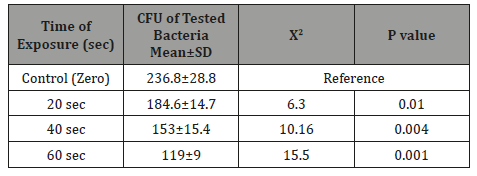
It is very obvious that the values of CFU decreased significantly (p=0.001) as the time of exposure difference increased between groups until reaching the highest value when the difference was 60 seconds. There was significance effect of visible blue light on the CFU of anaerobic periodontal pathogens Aggregatibacter actinomycetemcomitans in-vitro at different light exposure time. There was increase in the inhibition of growth in which the inhibition rates for 20sec exposure, 40sec exposure and 60 sec exposure were 41.2%, 54.2%, and 64.5% respectively. Also, there was decrease of Mean±SD of CFU as we proceed from A: zero seconds of light exposure, B:20S, C:40S and D:60S [305.6±36.9 to 179.7±18.6(20S), 140±15.9(40S) and 108.6±13.8(60S)]. In intergroup comparison CFU of the bacteria at each period of light exposure time was compared to the CFU at all the periods of light exposure. There was a high significant statistical difference between the control group (had no light exposure) and the 60 second group (p=0.001) (Tables 1-4) shows the phototoxic effect of visible blue light on the CFU of anaerobic periodontal pathogens Pg at separate vBL exposure time. It is very obvious that the values of CFU decreased significantly (p<0.001) as the time of exposure difference increased between groups until reaching the highest value when the difference was 60 seconds. By comparing with zero exposure, the inhibition rates for 20sec exposure, 40 sec exposure and 60 sec exposure were 22.04%, 35.4%, and 49.7% respectively. Also, there was decrease of Mean±SD of CFU as we proceed from A: zero seconds of light exposure, B:20S, C:40S and D:60S (236.8+28.8 at zero time to 184.6±14.7, 153.1±15.4, and 119±9 respectively).
Table 1: The phototoxic effect of visible blue light on the CFU of anaerobic periodontal pathogens Aggregatibacter actinomycetemcomitans at different light exposure time.
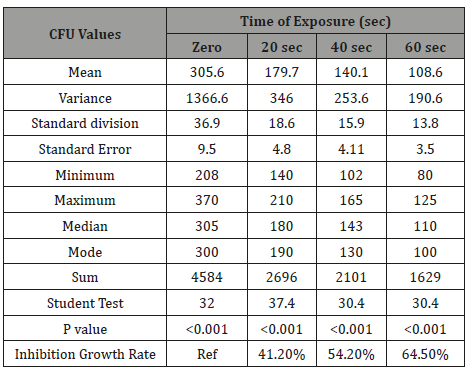
Table 2: The significance of the phototoxic effect of visible blue light on the mean±SD CFU of anaerobic periodontal pathogens Aggregatibacter actinomycetemcomitans at different light exposure time.
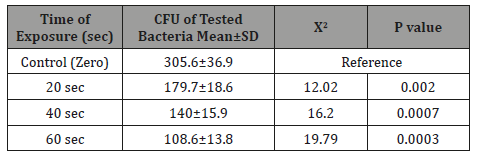
Table 3: The phototoxic effect of visible blue light on the CFU of anaerobic periodontal pathogens Porphyromonas gingivalis at different light exposure time.
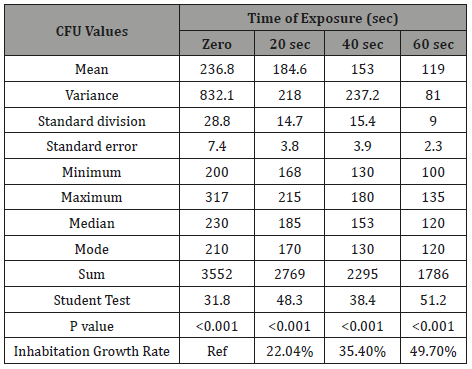
Table 4: The significance of the phototoxic effect of visible blue light on the mean±SD CFU of anaerobic periodontal pathogens Porphyromonas gingivalis at different light exposure time.
Discussion
In the current study there was significance effect of visible blue light on the CFU of anaerobic periodontal pathogens Aa invitro at different vBL exposure time in culture media in which the inhibition rates for 20 sec exposure, 40 sec exposure and 60 sec exposure were 41.2%, 54.2%, and 64.5% respectively in comparing with zero exposure time (Table 1). Also, the Mean±SD of CFU were significantly decreased from 305.6±36.4 at zero time to 179.7±18.6(20 sec), 140.1±15.9 (40 sec), and 108.6±13.8 (60 sec) respectively (Table 2). These results confirmed the toxic effect of visible blue light on Aa. This effect can be explained by the fact that the function of external light transformers is to absorb visible light that matches the wavelength of peak absorption, and then to cause a photochemical mechanism that kills bacteria [18-20]. The results of the current study are similar to those reported by Henry et al, [20]. Visible blue light has been shown to have toxic effects on Porphyromonas, Prevotella species [21,22], and similar effects were observed when visible light was used against gum Porphyromonas gingivalis and Fusobacterium nucleatum [23]. The findings regarding P. gingivalis were also consistent with a study conducted in Korea but in disagreement with the same study as far as the results of Aa were not found as any significant phototoscopic effect of visible blue light against Aa. They also found that there is a toxic effect of visible blue light emitted by the source of a light halogen therapy device on planktonic anaerobic gingival pathogens [10]. A significant statistical difference was observed in the CFU comparison of Aa at different periods of exposure to vBL, as well as a significant statistical difference in comparison of CFU of Pg at different periods of exposure to vBL. This means more exposure time leads to more bacterial death. This can be explained by the decrease of bacterial CFU for both Aa and Pg directly with the period of exposure to blue light curing. Low bacterial CFU is also explained by the killing ability of light and temperature against these bacteria. Kariam and René found vBL (408-750nm) in 2009 to be intrusive and cause damage to the metabolism and membranes of bacteria [24].
In addition, light sources have significantly stronger effects with reactive oxygen radicals occurring jointly with normal light converters, such as humic acid or protoporfirin. It has also been found that bacterial enzyme synthesis such as Super Oxide Dismutase and bacterial catalyze have been shown to decrease independently with the effects of light [24]. The results of the current study clearly indicate that the effect of blue light exposure increases as the exposure time increases, the greater the blue light exposure difference between the groups, the greater the difference between CFU, the best results were obtained when there was a difference (60 seconds), and the comparison results were significant in both organisms. In conclusion, there was a phototoxic effect of visible blue light emitted by a light therapy device against anaerobic gum pathogens. Moreover, one of the advantages of PDT as a visible blue light is its safety, as confirmed by Dai et al. [25,26], Ramakrishnan et al. [27], Zhang Y et al. [28]. They showed that under some exposures, there were no cytotoxic or gene-toxic effects on the relevant host cells. In addition, no evidence of genotoxicity of visible blue light (aBL) was observed in mouse skin in vivo when subjected to therapeutic exposure to aBL for inactivating mature biofilms [29].
Conclusion
In the conclusions, there was a phototoxic effect of visible blue light emitted by a light therapy device against anaerobic gingival pathogens and exposure to blue light is effective in reducing gum pathogens. It is recommended to use an exogenous photo sensitizer and that pathogens are exposed to visible light for clinical antimicrobial treatment.
For more open access journals in iris Publishers
https://irispublishers.com/journals.php
For more articles in Dentistry & Oral Health:
https://irispublishers.com/ojdoh/
Read more: Full Text

Comments
Post a Comment