Iris Publishers - Online Journal of Dentistry & Oral Health| UV Irradiation as a Disinfection Method to Reduce Covid-19 Cross-Contamination in Dentistry: A Scoping Review

Introduction
The beginning of the epidemic disease caused by the new coronavirus (COVID-19) was notified in December 2019. On January 30, 2020, World Health Organization (WHO) announced that this would be an emergency outbreak of public health and international interest. In early march, COVID-19 was detected in many countries and was therefore compatible with a pandemic [1-8].
The transmission of the new coronavirus occurs mainly through direct means, through coughing, sneezing, and inhalation of droplets present in the air, however, it can also occur through indirect means, through contact with contaminated mucous membranes, hands, objects, and surfaces [2-4, 9-15]. Therefore, the dental office is a place of a high risk of contamination, mainly through aerosols suspended in the air and decanted on surfaces [16]. As the pandemic progressed, concerns about the biosafety of health professionals and prevention of cross-infection increased, as did concerns about the worldwide shortage of critical personal protective supplies and protective equipment (PPE) [1,2,17-19]. The PPE most used by these professionals are gloves, long-sleeved aprons, glasses, surgical masks, visors, and respiratory masks of the type n95 or PFF2 [1, 2, 17, 20-23], all of which are manufactured for single use [1].
Due to the increase in the number of cases and the difficulty in maintaining basic supplies of individual protection for health professionals, it was started to think about ways to reuse them. Most conventional sterilization technologies used in hospitals or dental offices cannot effectively reprocess PPE due to the nature of their modalities, which will damage them [1]. Given that coronavirus and other respiratory viruses are significantly less resistant to sterilization modalities, the use of high to moderate level disinfection is sufficient to meet the needs of PPE reprocessing, and ultraviolet C (UV-C) irradiation can be effective for this purpose [1,24,25].
UV-C is proven to reduce bacterial and viral contamination in several health services, addressing the disinfection of air, water, and surfaces [26-29]. In this sense, the question is: will this technology help us to control infections at the dental office level? Can we use it to disinfect objects and PPE? This article aims to review the literature in order to elucidate the use of technologies based on UV-C for disinfecting surfaces and environments in different fields in the health area, and how these can be inserted in the routine of the dental office. , aiming to decrease the risk of cross-infection by COVID-19.
Materials and Methods
Identify the research question
Can ultraviolet (UV) light be used to disinfect contaminated environments and surfaces in the health area? How can we insert it into the routine within the dental office, aiming at reducing the risk of cross-infection by COVID-19?
Data collection and identification
Systematic searches were performed through the identification of descriptors and the use of the Boolean operator (AND). The following descriptors were used: UV disinfection, UV disinfection and COVID-19, UV disinfection and dentistry
1) The year of publications was defined, from 2018 to 2020, as well as the English language.
2) The research was carried out in April 2020, in the PubMed database.
3) The articles were selected after a thorough analysis of their abstracts.
Selection of studies
The studies first selected were those that contained subjects related to UV disinfection in health care fields, their abstracts were carefully read and in a second selection, only research related to the dental field or that could be referred to dentistry were chosen.
Results
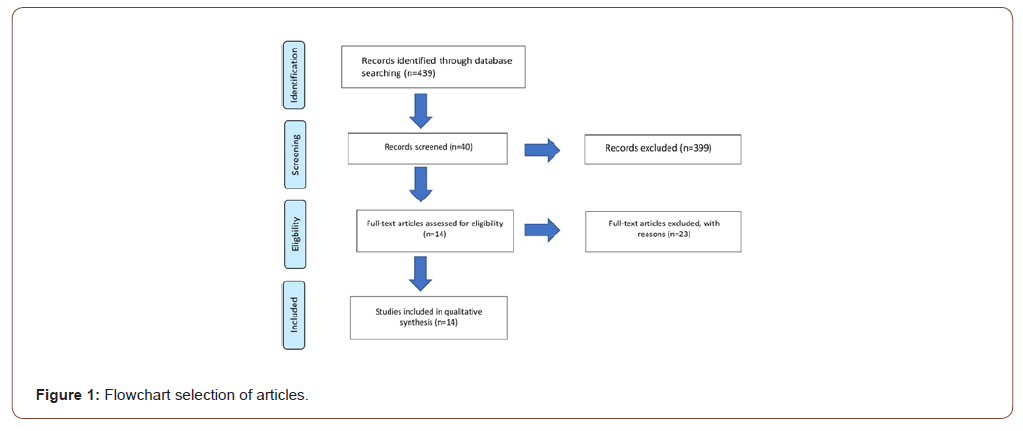
14 studies were selected for analysis and discussion.
(Figure 1).
Discussion
With the pandemic imminent, the scarcity of PPE materials and knowing that the new coronavirus can survive at least 3 days in a variety of materials (stainless steel, plastic, glass, etc.) [15, 26, 30, 31], several disinfection methods have been studied to decrease the risk of cross-contamination, including ultraviolet radiation. Ultraviolet radiation is a fraction of the electromagnetic spectrum that covers wavelengths below visible light. It is sub-divided into UV-A (ultraviolet A) with wavelengths from 320 to 400nm which is capable of causing changes in the skin causing aging; UV-B (ultraviolet B), with wavelengths from 280 to 320nm, which causes genetic mutations and can lead to skin cancer [32]; and UV-C (ultraviolet C) with wavelengths from 200 to 280nm [32-34], which is the most harmful band, being the germicidal band, interacting directly with the genetic material of the microorganisms, inactivating them and interrupting their contagion cycle [32].
UV irradiation has been proposed as a method of terminal disinfection in a variety of applications such as air, water, and contaminated surfaces [26, 28, 29, 35-38], and it can also be generated sin different ways, the most traditional being the mercury gas lamp. Currently, new technologies are being used without the presence of mercury, such as xenon pulsed light (200 to 300nm) that is emitted in a short duration, high pulse intensity, requiring a shorter exposure time [1, 36, 39], and the technology based on LED (light emitting diode), which proposes the use of smaller equipment, with fast start up time and equal efficiency, however, with low energy load [40]. Regardless of the source of ultraviolet light, the most effective wavelength is 254nm [36,39- 45]. After UV irradiation, the DNA sequence of microorganisms can form pyrimidine dimers, which can interfere with DNA duplication, as well as lead to the destruction of nucleic acids and make viruses non-infectious [44].
According to a systematic review carried out in 2015, surfaces such as stethoscopes, cell phones, pagers, computers, tablets, and other objects present in outpatient and hospital environments are susceptible to contamination by bacteria and viruses. The use of germicidal wipes and the use of other chemical disinfection methods, mainly for use in electronic equipment, are discouraged by some manufacturers, for example, the user manual for Apple devices recommends that “soft, lint-free cloth should be used to clean the device”. However, just a cloth is not enough to disinfect a contaminated surface [46]. A recent study evaluated whether regular cleaning with any germicidal towel or UV-C irradiation decreases microbiological levels compared to irregular cleaning. They concluded that both methods of disinfection are effective and that UV-C irradiation can be a great alternative to objects and surfaces that cannot be disinfected with chemical substances [46].
Napolitani et al. (2020) [41], investigated the effectiveness of a ‘wearable in aprons’ device that emits ultraviolet C light by LED in the disinfection of stethoscopes, and through preliminary studies discovered a similar device that proved to be effective. In 10 stethoscopes analyzed, the average number of CFU was 9.5 after treatment and 75.9 without treatment. In another study, 3 auscultations were performed on a volunteer. The first was performed as a control, while the other two tested the disinfection capacity of UV-C LEDs. A total of 104 CFU were found at the baseline, while 12 and 15 CFU were found after 2 independent tests. Another study was conducted in a private clinic, the sample not treated with UV-C showed 132.2 CFU while the treated sample showed contamination of 6.9 CFU in stethoscopes [41].
A study proposed at a teaching hospital in China evaluated infection control in animal laboratories and the disinfectant effects of portable pulsed xenon (PX-UV) ultraviolet device. Samples were taken from the survey surface, door handles, scales, trolley handles, and air in the barrier system. A manual cleaning using cloths moistened with 0.5% peracetic acid on surfaces and spraying 1% peracetic acid in the air was done in a pre-PX-UV way in one group and another not. The device was set at a wavelength of 100mn to 400nm, a frequency of 3Hz, and working duration of 6 min. PX-UV disinfection significantly reduced the count of residual microorganisms in the group with previous manual cleaning; From 10 to 1. Without manual cleaning, the PX-UV was also effective, with an average count dropping from 6 to zero. In the air it reduced the microorganism count from 6 to zero, too. They concluded that PX-UV is an effective tool for disinfecting pathogens in various environments [47].
The disinfection of ambulances is extremely critical and necessary to prevent cross-contamination. Song et al. (2020) [36] carried out a study to test whether a UV irradiation device would be able to reduce pathogens in this environment, with the prerogative that manual chemical disinfection is dangerous and prone to error; based on a study that says persistent contamination is still found in the patient’s compartment even after manual cleaning with chlorine and hydrogen peroxide. This device, manufactured for ‘closed air’ and that can be used in the presence of people, being powered and operated automatically when the ambulance is started, was evaluated by measuring the level of bioaerosol before and after UV disinfection and obtained as a result of more than 90% disinfection after UV light [36].
In 2020, Szeto et al. [39] conducted a study where several suspensions of bacteria and viruses were added to the filter paper and subjected to illumination by UV-C light generated by low-pressure Hg vapor lamps. The extension of the pathogen and inactivation at different times of illumination was investigated through a series of experiments. In the best-tested situation, bacterial inactivation can be achieved in less than or equal to 10 minutes of treatment with UV-C, except for mycobacterium tuberculosis, which required about 30 min of treatment. For viruses, especially influenza viruses, 20 minutes of treatment were necessary, indicating that UV-C light is an effective approach against different microorganisms 39, a fact that goes in accordance with what Kim and Kang say in 2018 They claim that microorganisms that contain DNA do not have a repair system, being more vulnerable to UV-C irradiation than microorganisms that have RNA [42].
Bringing UV-C to the dental reality, Binns et al. [48] (2020) investigated the effect of 254nm ultraviolet light in the disinfection of candida albicans in polymethylmethacrylate prosthesis bases. They found that exposure to UV-C light of 300s inhibited the survival of C. albicans close to the level of 3.8% sodium perborate, however, perborate can cause roughness on the surface of the prosthesis, so ultraviolet irradiation is an effective alternative for this purpose [48]. Regarding the use of UV-C light in the disinfection of PPE, the literature is still very scarce. The last study carried out on masks proved to be effective and did not affect the penetration of the aerosol into the masks’ filters and did not change their appearance. However, attention must be paid to the exposure time and further studies must be carried out to prove this purpose [1].
With regard to contaminated water, most studies evaluate disinfection in pathogens that cause gastrointestinal infections. Rockey et al. [49] (2020) found that UV-C irradiation was effective in inactivating the HuNov virus. Another study evaluated disinfection in water containing rotavirus and Tulane virus, where they obtained an interesting result: due to different genomes and capsids, they were the target of UV irradiation in different ways. UV irradiation decreased the binding of the Talune virus to its receptor on the host and mutated its genome. Regarding rotavirus, UV irradiation allowed the interaction between viruses and hosts but prevented the replication of its genome. UV-C irradiation is also effective for this purpose [49].
In contrast to everything that has been said previously, Ciofi Silva et al. [50] (2019) evaluated the presence of residual Nov- GII particles in floors and air particles, following various floor decontamination procedures. Two types of flooring (vinyl and granite) were contaminated with human feces positive for the virus. Two decontamination protocols were implemented: cleaning followed by disinfection with 1% sodium hypochlorite and cleaning followed by disinfection using a manual UV-C light device for 30 min. Samples were collected from the floor and from the air, as the virus in question can be aerosolized while cleaning the floor and its particles can be inhaled, swallowed, or set under surfaces. The disinfection protocol with 1% sodium hypochlorite after cleaning proved to be more effective. In the air, there was no statistically significant difference between the types of flooring [50].
Conclusion
There are not many studies in the literature related to the use of ultraviolet C light in dentistry. However, through studies in other areas, we can predict its use in it. Regarding the disinfection of surfaces and objects liable to contamination, UV-C light (254nm) proved to be effective, mainly associated with previous manual cleaning. This disinfection scheme can be used in clinical rooms between patients, in furniture, cell phones, computers, for example. The elimination of fungi in dentures with UV-C light proved to be a plausible alternative, however other microorganisms should be tested. In PPE’s, its use is possible through proper exposure and handling; Further studies should be carried out in this regard regarding the use of UV-C light in different scenarios and conditions.
Disinfection of contaminated air has also proved to be effective, but studies are lacking showing its effectiveness in aerosols generated by dental procedures, which are highly contaminated. With the COVID-19 pandemic and the growing concern about biosafety and cross-infection, it is suggested that further studies aimed at disinfection by ultraviolet light in the dental area be suggested, so that it can be used safely and effectively.
For more open access journals in iris Publishers https://irispublishers.com/journals.php
For more articles in Dentistry & Oral Health: https://irispublishers.com/ojdoh/
Read more: Full Text
To know more about iris publishers reviews: https://www.sitejabber.com/reviews/irispublishers.com

Comments
Post a Comment