Iris Publishers - Online Journal of Dentistry & Oral Health| The Role of Hyperbaric Oxygen Therapy in the Treatment of Head and Neck Cancer Patients after Radiotherapy with Dental Implants

Authored by Esra Nur Avukat,
Introduction
The National Cancer Institute defines HNC as a neoplasm that arises in the oral cavity, paranasal sinuses, salivary glands, pharynx and larynx [1,2]. Treatment of HNC is a difficult and long-lasting disease. HNC treatment includes therapies like surgical resection, radiotherapy, chemotherapy or a combination of these [3,4]. 80% of HNC patients receive radiotherapy at some stage of their treatment [5]. However, high-dose radiation therapy induces many side effects, such as xerostomia, fibrosis of the oral mucosa, mucositis, loss of taste, temporomandibular joint disorders, reduced mouth opening, compromised aesthetics, candidiasis, implant failures and ORN. These complications negatively affect the quality of life of patients [3, 6-10].
Successful prosthetic restoration after cancer surgery becomes difficult due to the size, shape and location of the defect. In addition, the changes that occur after radiotherapy make the construction of the prosthesis even more difficult. Therefore, careful treatment planning should be done. A good prosthetic rehabilitation is an important factor for patients to regain their lost functions. The changing anatomy makes it difficult or sometimes impossible to treat with removable dentures, especially for patients with completely edentulous. Tissue-supported prostheses are likely to develop trauma [7,10,11]. Ulcerations may occur due to dry mouth and sensitive mucosa in patients using removable dentures after radiation. This can cause serious infections or even ORN development [12]. ORN occurs in bones such as the sternum, skull or pelvis, but often affects the mandible. Treatment of ORN is difficult [13].
Intraoral anatomical changes that occur after surgery and radiotherapy make it difficult to prepare a prosthesis with good stability and retention [14]. Dental implants increase the support and stability of dentures. Recently they play an important role in the rehabilitation of cancer patients [7]. With the osseointegrated implants, the retention of the prosthesis is increased and the risks that cause mucous irritation are eliminated. Thus, it is thought that the burden on sensitive soft tissues will be reduced and the possibility of necrosis will be prevented. Patients can better mastication, thus improving their quality of life [15-17].
Many factors are important for implant survivors such as age, gender, applied radiation dose, type of radiotherapy applied, the time between radiotherapy and implant surgery, the quality and topography of the bone in the region where the implant is placed, and the surgical procedure applied. Implants are placed as primary or secondary [18-21]. Placing the implants in the same session as ablative and reconstructive surgery is called primary placement. The primary placement has advantages such as avoiding additional surgery, not needing additional treatments such as HBOT, save costs on extra operating sessions, and osseointegration occurring before radiotherapy [22,23]. In secondary implant placement, implants are placed after radiotherapy. Secondary placement provides an advantage to assess the patient’s motivation, psychological state, and prognosis of cancer [22]. However, when implants are inserted into the irradiated bone, the rate of failure increases: the side effects of radiotherapy can result in progressive fibrosis of the vessels and soft tissue, resulting in decreased recovery capacity. In addition, radiation decreases bone vascularity, clinically this condition occurs as ORN. This prevents osseointegration of implants. Ionizing radiation damages bone, periosteum, connective tissue and vascular endothelium and causes loss of resistance in tissues. This situation causes hypoxia, hypovascularity, and reducing cell numbers in the future. However, resistance to trauma and infection decreases [24,25]. Tissue dehiscence and ORN are possible side effects and can cause implant failure [26]. For these reasons, dental implant treatment was accepted as a contraindication in patients undergoing radiotherapy [13]. Long-term use of antibiotics or HBOT has been recommended to prevent the occurrence of these complications [10].
The HBOT protocol was introduced by Marx in 1985. HBOT is a systemic treatment method in which patients inhaled to intermittent, short term 100% pure oxygen under a pressure of greater than 1 atmosphere in a specially designed chamber, once or twice a week. HBOT protocol is applied as twenty treatment sessions before surgery and ten treatment sessions after surgery. As a result of treatment, the amount of dissolved oxygen in plasma and tissues increases [12, 27-30].
The Hyperbaric Oxygen Committee of the Undersea and Hyperbaric Medical Society currently recommends HBO for several uses, including air or gas embolism, carbon monoxide poisoning, severe anemia, intracranial abscess, necrotizing soft tissue infections, refractory osteomyelitis and others (www.uhms.org) [13,30]. It is recommended to use HBOT in risky areas to increase blood flow before implant surgery [31]. It has been reported in published studies that HBOT increases fibroblastic, osteoblastic, and angioblastic activity in tissues [32,33]. The results obtained from the studies, increased bone mineralization and increased force required to remove the implants support these assumptions [14, 31]. However, it should be remembered that HBOT has side effects such as middle ear barotrauma, development reversible myopia, and aggravation of congestive heart failure [13]. In addition, patient compliance must be good for HBOT. However, expensive equipment is required and is a costly treatment for patients [30].
Surgical treatment after radiotherapy can lead to the development of ORN. HBOT has been proposed to improve the success of implant therapy. It has been suggested that HBOT will improve the healing of bone and soft tissues around the implant in patients undergoing radiotherapy. Nevertheless, this issue is still controversial today [12]. Currently, there is no consensus on the effect of HBOT on osseointegration and implant survival development in cancer patients who receive radiotherapy [34]. For this reason, the purpose of the review is to review the use and benefits of HBOT in patients undergoing radiotherapy for HNC. Therefore, the main question asked in the review: What is the role of HBOT in dental implant treatments in HNC patients treated with radiotherapy?
Table 1:A summary of the current literature.
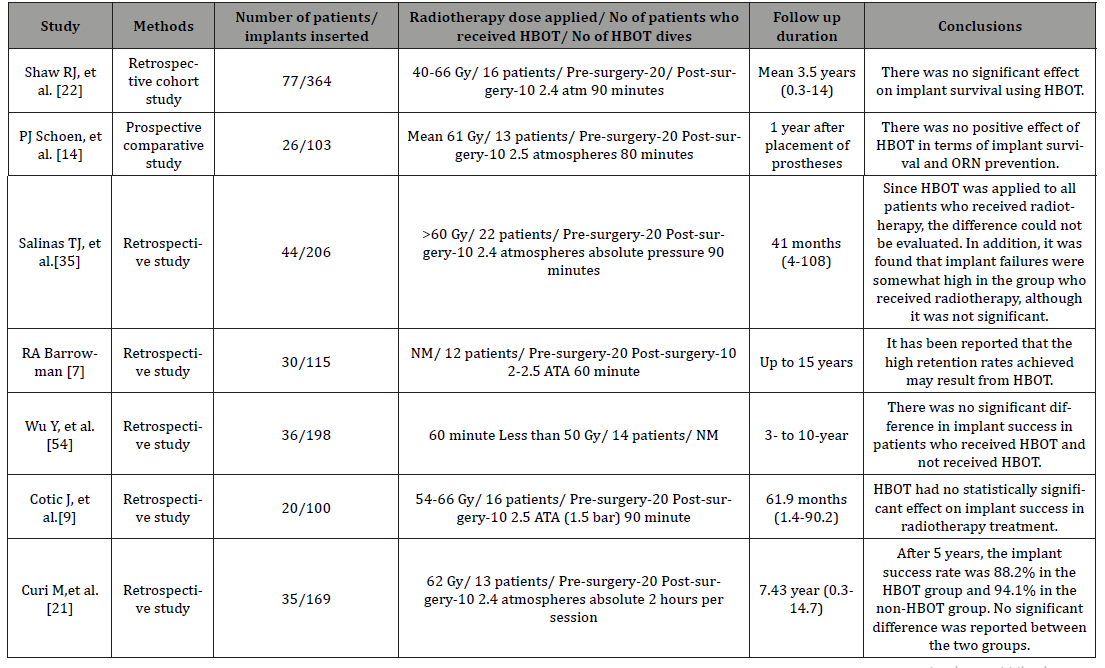
Study, methods, number of patients/implants inserted, radiotherapy dose applied/ no of patients who received HBOT/ no.of HBOT dives, follow up duration, and study conclusion are summarized in (Table 1) articles were reviewed; these are summarized in (Table 1).
Discussion
Before 1986, patients who had irradiated their head and neck region were not treated with dental implants due to the negative effects of radiotherapy on osseointegration and wound healing [36]. Today dental implant treatment is a reliable treatment method in irradiated HNC patients after surgical and prosthetic procedures are applied correctly [9]. However, oral rehabilitation of cancer patients exposed to radiation should be performed in experienced clinics and a multidisciplinary team, taking into account the complications that may occur [7,17]. The team should include medical and radiation oncologists, surgeons, maxillofacial prostodontists, medical engineers, and hyperbaric medicine [7,22,37].
Studies have reported that implant survival rates are higher in patients not receiving radiotherapy after tumor surgery [24,36- 39]. Dental implant failures are rare in doses less than 45 Gy. In published studies, the risk of implant failure has been reported to be increased due to loss of repair and neovascularization in irradiated bone at radiation doses of 50 Gy and above [24,38,40- 43]. There is no consensus on whether HBOT should be used as adjuvant therapy in patients undergoing radiotherapy. Various authors have reported that adjuvant HBOT should be applied to increase the viability of bone and soft tissue, reduce the risk of ORN, and improve osseointegration before implant surgery. Increased oxygen amount, collagen production, and fibroblastic activity increase capillary neoangiogenesis and bone formation [14,20, 44- 46].
In studies, it is recommended that HBOT be used to prevent ORN in cases where a dose of more than 50 Gy and radiation damage shows clinical signs [7,45,47,48]. There are also studies reporting that the total radiation doses between 50 and 60 Gy are limit values for rehabilitation with dental implants without the need for additional treatments such as HBOT [22, 49-51]. In a systematic review published by Shah et al in 2017, it has been reported that HBOT reduces the risk of implant failure by increasing vascularization in patients undergoing radiotherapy [20].
Curi et al., reported a success rate of 88.2% for 5 years in 13 patients undergoing HBOT. In 22 patients without HBOT, this rate was reported as 94.1%. As a result, no significant difference was reported between the two groups [21]. Mancha De La Plata et al., applied HBOT to 4 patients who developed ORN after radiotherapy. They reported that dental implants can be applied after radiotherapy without the need for HBOT [25]. In 2007, Schoen et al., started broad spectrum antibiotic prophylaxis (cefradine 1g, 3 times a day for 2 weeks) one day before surgery in 13 patients in the control group. 13 patients in the test group received HBOT 20 preoperatively and 10 postoperatively. In addition, antibiotic prophylaxis applied to the test group was applied to the control group. 8 implants failed in 5 patients in the test group, 3 implants failed in 2 patients in the control group. More implant loss was observed in the group with HBOT. As a result, it has been reported that HBOT cannot prevent dental implant failure and complications such as ORN caused by radiotherapy [14]. In published studies, it has been reported that a positive effect of HBOT on implant success was not observed [18, 25, 42,52,53]. In a study conducted by Wu et al. in 2016, it was reported that there was no significant difference in implant success in the group that received HBOT [54]. In systematic reviews published in 2003 and 2008, Coulthard et al. reported that they did not find evidence to support or refute HBOT administration to improve implant survival in patients undergoing radiotherapy [13,30]. Another Cochrane review published by Esposito et al., HBOT has not been reported to have a positive effect on the success of implants placed in radiotherapy-treated jaws. In addition, in this review it was reported that more clinical studies are needed on the subject [12].
Conclusion
When the current limited number of studies are evaluated, it can be seen that HBOT may not provide significant clinical benefit in HNC patients with radiotherapy. In most studies, the time interval between radiotherapy and HBOT is not mentioned. The time between radiotherapy and implant surgery can also affect success. In addition, the studies carried out have limited cohort size and short follow up periods. Therefore, there is a need for randomized, controlled, double-blind trials with homogeneous patient distribution, longer follow-up, supporting HBOT use after RT. Finally, since each center may have a limited number of patients, it is necessary for researchers to consider that these studies may need to be multi-centered.
For more open access journals in iris Publishers https://irispublishers.com/journals.php
For more articles in Dentistry & Oral Health: https://irispublishers.com/ojdoh/
Read more: Full Text
To know more about iris publishers reviews: https://www.sitejabber.com/reviews/irispublishers.com

Comments
Post a Comment